Overview
The Odyssey is a 2026 American epic action fantasy film written, directed and produced by Christopher Nolan, who produced it with his wife Emma Thomas. An adaptation of Homer's ancient Greek poem, it stars Matt Damon as Odysseus, the king of Ithaca, whose twenty-year journey home from the Trojan War brings him face to face with gods, monsters and the consequences of his own choices. An ensemble cast includes Tom Holland, Anne Hathaway, Robert Pattinson, Lupita Nyong'o, Samantha Morton, Zendaya, Charlize Theron, Jon Bernthal and Himesh Patel.
The film premiered at the Odeon Luxe Leicester Square in London on 6 July 2026 and was released theatrically by Universal Pictures on 17 July in the United States and the United Kingdom. Running 173 minutes, it was the first feature film shot entirely on IMAX 70 mm film cameras. With an estimated budget of $250 million, it is among the most expensive films of Nolan's career.
The Odyssey grossed approximately $1.804 billion worldwide, becoming Nolan's highest-grossing film, the second-highest-grossing film of 2026, the highest-grossing R-rated film ever, the highest-grossing film distributed by Universal and the eleventh-highest-grossing film of all time. Critical response was broadly acclaiming: reviewers praised the direction, performances, practical effects and scale, while some criticised Nolan's departures from the source poem.
This article is an independent reference work. It summarises publicly available reporting and reference sources, with links to the original material. Plot details are discussed openly in the story section, which is marked as containing spoilers.
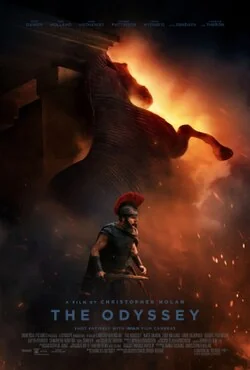
Quick facts
- Director
- Christopher Nolan
- Writers
- Christopher Nolan
- Producers
- Christopher Nolan, Emma Thomas
- Release
- 17 July 2026 (US/UK); 6 July premiere
- Runtime
- 173 minutes
- Studio
- Universal Pictures
- Music
- Ludwig Göransson
- Cinematography
- Hoyte van Hoytema
- Editing
- Jennifer Lame
- Budget
- $250 million (estimated)
- Worldwide gross
- $1.804 billion
- Lead cast
- Matt Damon, Anne Hathaway, Tom Holland
- IMDb
- tt33764258
- Format
- First feature shot entirely on IMAX 70 mm
Homer's poem and Nolan's interpretation
The source epic
Homer's Odyssey, composed roughly three thousand years ago, follows the Greek hero Odysseus after the fall of Troy. It is one of the foundational works of Western literature: a story about homecoming, cunning, hubris and the price of survival. Its episodes — the Cyclops, Circe, the Sirens, Scylla and Charybdis, the underworld, the slaughter of the suitors — have been retold in nearly every medium since.
The poem is also structurally unusual. It begins near the end of the hero's journey, with Odysseus absent and his household under siege, then moves backward through his own account of the adventures that kept him away. Nolan's film adopts that structure in broad terms, opening on Ithaca and the suitors before moving into the memories of war and voyage that explain how Odysseus became the man who must return.
Realism and the mythical
Nolan studied several translations before settling on an approach he described as a realistic interpretation of Greek mythology. He drew inspiration from epic historical films including Andrei Rublev (1966) and Ran (1985), and from the stop-motion traditions of special-effects artist Ray Harryhausen. The intent was to treat the mythic elements as physical realities within the world of the film rather than as symbolic or dreamlike intrusions.
That choice shapes the film's visual identity. The monsters are tactile and dangerous; the gods appear as people whose authority is felt through consequence rather than spectacle. The production's commitment to practical effects — animatronics, puppetry, makeup and stage magic — reinforces the idea that Odysseus is moving through a world with weight and resistance, not a series of digital backdrops.
Development and production
Writing and attachment
By November 2023, Nolan had not decided what his next film would be after Oppenheimer. He began writing a script in March 2024 and secured the project with Universal Pictures by October; the film was announced publicly in December. Casting unfolded from late 2024 through early 2025, with Matt Damon confirmed in the lead role in February.
Nolan's stated requirement was that he needed to “own it completely” — a phrase that reflects his preference for projects he can shape from script to final print. The Odyssey gave him a source text with enormous scope and a structure compatible with his interest in fractured chronology and moral ambiguity.
Filming across continents
Principal photography ran from February to August 2025 on location in Morocco, Greece, Italy, Scotland, Iceland, Western Sahara and Malta, as well as at the Universal Studios Lot in Los Angeles. Water-based filming took place from 15 April to 15 May around the Aeolian Islands of Lipari, Basiluzzo and Vulcano, which stood in for the mythological island of Aeolia. Local ordinances imposed safeguarding restrictions on some of these locations.
The production was the first feature film shot entirely on IMAX 70 mm film cameras. Film stock alone cost roughly $3 million. The negative was scanned to high-resolution digital files for editor Jennifer Lame's initial cuts, then cut and spliced by hand for the final print. Colour grading used analogue filters on a light table, with numerical values assigned to each shot — a workflow that reflects Nolan's long-standing commitment to photochemical film.
Effects and creatures
DNEG provided visual effects, with Andrew Jackson as supervisor. The Cyclops and Laestrygonians were largely physical creations; Bill Irwin performed on set as Polyphemus. The sequence in which Circe turns Odysseus's crew into pigs combined animatronics, puppetry, makeup effects and stage magic. The six-headed Scylla was predominantly digital, but Nolan drew on Guillermo del Toro's approach to monsters — that a monster must be treated as a character, not an effect. A ratchet system lifted stunt performers during the attack, and jet skis circling in water were filmed as reference for the whirlpool later replaced digitally.
Plot
Spoiler notice: this section describes the complete plot, including the ending.
Ithaca under pressure
Odysseus has not returned from the Trojan War in twenty years. Suitors led by the nobleman Antinous aggressively court Penelope, hoping to claim the throne from her and her son Telemachus. Only Penelope, Telemachus and the half-blind servant Eumaeus believe Odysseus is alive. Penelope warns her son about murderous “Sea Peoples” who violate Zeus's law of hospitality. Telemachus travels with Mentor to Sparta to ask King Menelaus where his father is, while Antinous plots to ambush him on his return.
Memory of the war
The goddess Athena appears to Odysseus on Ogygia, where the nymph Calypso is infatuated with him, and orders him to return home. Calypso encourages him to remember his past. Years earlier, the Greek army under Agamemnon conquered Troy through Odysseus's stratagem of the Trojan Horse, with the soldier Sinon sacrificed as a decoy. After the sack, Odysseus and his crew landed on an island for supplies and were trapped by the Cyclops Polyphemus, who devoured several soldiers. They blinded him and escaped, but his cry to his father Poseidon doomed them to harsh seas.
At Telepylus, man-eating Laestrygonians killed most of the crew and sank two of three ships. The survivors rebelled, leaving Odysseus with one ship. On Aeaea, the witch Circe turned the men into pigs; after Odysseus persuaded her to restore them, she told him he must cross the river Oceanus into Hades to find his way home.
The underworld and the return
In Hades, Odysseus meets his fallen soldiers. Sinon's shade reproaches him for the deception that cost his life and reveals that Antinous manipulated him into taking another man's place in the army. Agamemnon's shade tells how his wife Clytemnestra murdered him on his return to avenge their daughter Iphigenia. The prophet Tiresias predicts that only Odysseus will return home. Chased from the underworld by the dead, Odysseus survives the Sirens and the monsters Charybdis and Scylla. On Thrinacia his starving men kill Apollo's cattle despite his warning; Zeus sends a storm that sinks the ship, leaving only Odysseus, who washes ashore on Ogygia, where Calypso's lotus flowers have made him forget who he is.
After seven years he regains his memories, builds a raft and surrenders to the storm. He lands in Ithaca disguised as Sinon. Bandits sent by the suitors kill Mentor and nearly kill Telemachus, but Odysseus saves him; the elderly dog Argos dies after recognising his master, and Telemachus works out the truth. At a feast, Odysseus confronts Antinous over Sinon's betrayal and is beaten, until Telemachus intervenes.
The bow and the reckoning
Still disguised, Odysseus confesses to Penelope that he desecrated Athena's statue after killing her priestess, violated Zeus's law during the sack of Troy and set in motion the Bronze Age collapse. He reveals that the “Sea Peoples” were the Greeks themselves, and asks for forgiveness. Penelope announces she is ready to remarry: she will wed whoever can string Odysseus's bow and shoot an arrow through a row of axe heads. The suitors fail; Odysseus succeeds and reveals himself. A battle erupts; Telemachus helps him kill the most dangerous suitors, including Antinous. After the rest surrender, Odysseus cedes the throne to Telemachus and leaves with Penelope to seek peace in exile, sailing west to honour his fallen soldiers.
Cast and characters
| Actor | Character | Role in the story |
|---|---|---|
| Matt Damon | Odysseus | King of Ithaca, strategist and survivor |
| Anne Hathaway | Penelope | Queen of Ithaca, holding the household together |
| Tom Holland | Telemachus | Odysseus's son, searching for his father |
| Robert Pattinson | Antinous | Leading suitor and political opportunist |
| Lupita Nyong'o | Helen / Clytemnestra | Dual role as Menelaus's wife and Agamemnon's killer |
| Samantha Morton | Circe | Witch of Aeaea |
| Zendaya | Athena | Goddess who guides Odysseus home |
| Charlize Theron | Calypso | Nymph who offers immortality on Ogygia |
| John Leguizamo | Eumaeus | Blind swineherd and loyal servant |
| Jon Bernthal | Menelaus | King of Sparta |
| Himesh Patel | Eurylochus | Odysseus's second-in-command |
Themes and interpretation
Homecoming as moral reckoning
The poem's central word is nostos — homecoming. Nolan's film treats it less as a reward than as a confrontation. Odysseus does not return to a waiting family and resume his old life; he returns to a household that has been governed in his absence and to a son who has had to become a man without him. The journey's real test is not survival but whether he can tell the truth about what he did to get home.
Guilt and the cost of cunning
Odysseus is a strategist, and the film repeatedly asks what his cleverness costs other people. The Trojan Horse saved the Greek army but required Sinon's sacrifice. His manipulation of the suitors and his final revelation depend on the same capacity for deception that got his men killed. The film's most radical move is to make the hero confess that the collapse of an entire civilisation can be traced to choices he made.
Memory, forgetfulness and identity
Calypso's lotus flowers erase Odysseus's memory; the underworld restores it. The structure lets the film treat identity as something reconstructed rather than simply recovered. Odysseus spends years as a man without a name, first among the dead and later as a disguised beggar in his own hall. His recognition by Argos and Telemachus matters because it happens before Penelope accepts him — the truth is known to the household's margins before its centre.
Myth versus history
Nolan's “realistic” approach raises the film's most discussed question: is the Odyssey a myth, a memory of real events or both? The film includes the Bronze Age collapse and the Sea Peoples, grounding its fantasy in historical anxiety, but it also stages gods and monsters as literal presences. Critics argued about whether that mixture clarifies the poem or imposes a modern historiography on it.
Gods, mortals and responsibility
Athena guides, Poseidon punishes, Zeus judges — but the film's moral centre remains human. The gods create conditions; people decide what to do within them. Odysseus's final act is not divine punishment but a domestic contest resolved by his own skill, followed by a choice to leave the throne rather than cling to it. That ending recasts the hero as someone who has finally understood the difference between power and legitimacy.
Music and sound
Ludwig Göransson composed the score, continuing a collaboration with Nolan that began with Tenet and continued through Oppenheimer. The soundtrack was released digitally by Back Lot Music on 17 July 2026, with a triple vinyl edition on 31 July and a double CD on 14 August.
The score is notable for its use of reconstructed ancient instruments. Callum Armstrong and Rosa Fragorapti played replicas of the aulos and lyre, researching ancient sources to understand how the instruments were used. That commitment to physical authenticity matches the production's wider approach: the music is built from materials that could plausibly have existed in the world of the story, then expanded through Göransson's modern orchestral writing.
English musician James Blake and American rapper Travis Scott, who appears in the film as a bard, contributed vocals. The two collaborated with Göransson on the original song “When I'm Home”, which plays over the closing credits; Nolan is credited as a co-writer. The song drew attention for bringing contemporary voices into an otherwise ancient soundscape, a contrast the film uses to underline the idea that this story is about memory rather than archaeology.
Release and marketing
The film premiered in London on 6 July 2026 and opened in the United States and United Kingdom on 17 July. Universal released it in IMAX and multiple premium large formats. The decision to open simultaneously in the two markets reflected the film's global scale and the strength of its English-language cast.
Marketing leaned on two ideas: Nolan's reputation as a maker of events, and the novelty of an entirely IMAX 70 mm shoot. Tickets for selected opening-weekend IMAX 70 mm screenings went on sale on 17 July 2025 — a full year in advance — an unprecedented move that turned the format into part of the story. Trailers and posters used the line “Defy the gods” and emphasized Damon's weathered Odysseus against vast seas and monumental architecture.
The film became available on digital platforms and Ultra HD Blu-ray on 17 November 2026, 120 days after theatrical release. The 4K HDR transfer uses a 1.78:1 aspect ratio and a DTS-HD MA 5.1 soundtrack. Releasing on physical media at the same time as digital was interpreted as another sign of Nolan's long-standing support for discs over streaming-only distribution.
Box office
As of 9 November 2026, The Odyssey had grossed approximately $626 million in the United States and Canada and $1.179 billion elsewhere, for a worldwide total of $1.804 billion. It became Nolan's highest-grossing film, the second-highest-grossing film of 2026, the highest-grossing R-rated film ever, the highest-grossing Universal release and the eleventh-highest-grossing film of all time.
Its international debut was $130.6 million from 12,700 theatres in 73 markets — Nolan's largest foreign opening, with France, Italy, India, Spain, Brazil, the Netherlands and Poland among the strongest territories. The combined global opening of $264.1 million surpassed The Dark Knight Rises to become Nolan's best.
IMAX 70 mm screenings were originally scheduled to end on 17 August but were extended to 16 September after selling out for seven consecutive weeks. That demand illustrates the film's unusual position: a three-hour epic on analogue film became a scarce theatrical commodity, and audiences travelled specifically for the format.
Critical reception
The film received widespread critical acclaim. Reviewers praised Nolan's direction, the ensemble performances, the practical sets and the sheer scale of the production. It became Nolan's highest-rated film on Rotten Tomatoes. Audiences polled by CinemaScore gave it an average grade of “A”, while 81% of PostTrak respondents said they would definitely recommend it.
The most frequent criticisms concerned the adaptation. Some reviewers questioned Nolan's depiction of Mycenaean Greece, while others argued that the poem is myth rather than history and should not be judged by archaeological standards. The use of contemporary American accents and 21st-century dialogue was also criticised, particularly for British actors Tom Holland and Robert Pattinson.
The casting of Lupita Nyong'o as Helen of Troy drew hostile commentary from conservative commentators, who framed it as a departure from traditional depictions. Other writers described that reaction as selective and more concerned with contemporary cultural politics than with fidelity to Homer. The debate became one of the most public arguments about the film.
“The film's greatest achievement is that it makes an ancient poem feel urgent without pretending that the ancient world was just like ours.”
The broad verdict, however, was that Nolan had delivered a rare kind of event film: one built on physical craft, difficult source material and a willingness to let a hero be morally complicated.
Debates and open questions
Faithful adaptation or modern reinterpretation?
Critics disagreed about whether the film's changes — the confessional sequence, the reframing of the Sea Peoples, the emphasis on guilt — clarified Homer or distorted him. The film does not present itself as a literal translation, but its realistic visual approach invites viewers to judge it as a reconstruction.
Is the poem myth or history?
Nolan's interest in the Bronze Age collapse places the film near a long scholarly argument about whether Homer preserved memories of real events. The film does not resolve that question; it uses history as atmosphere and myth as structure. Some critics found the combination compelling, others contradictory.
Language and accent
The decision to use modern American English was a deliberate accessibility choice, but it broke with the formal register many viewers expect from ancient epics. For supporters, it made the characters immediate; for detractors, it flattened the distance that gives the poem its power.
The length and the format
At 173 minutes, the film demands patience, and its IMAX presentation intensifies that commitment. The extended run of 70 mm screenings suggests audiences embraced the scale, but some reviewers argued that the film's middle section could have been tighter. The debate is inseparable from Nolan's reputation for making films that must be seen in a specific way.
Legacy and what comes next
The Odyssey confirmed that a long, R-rated, dialogue-heavy epic could reach a global audience when built around a singular directorial vision and a distinctive exhibition format. Its $1.804 billion gross set new benchmarks for Nolan, Universal and the R-rated category, and its IMAX 70 mm run became a case study in format-driven demand.
For Nolan, the film completes a remarkable run that includes Inception, Interstellar, Dunkirk, Tenet and Oppenheimer. It also demonstrates his growing interest in adapting foundational texts rather than only exploring scientific or historical subjects. For Matt Damon, it provided one of the most substantial roles of his later career.
No further film had been officially confirmed at the time of writing. The ending is conclusive — Odysseus and Penelope leave Ithaca rather than return to power — and the production's scale makes a direct sequel unlikely. The more probable legacy is a wave of interest in large-format historical epics and renewed debate about how ancient stories should be brought to the screen.
That debate is likely to outlast the film's box-office records. The Odyssey asks whether a foundational poem can be made immediate without becoming ordinary, and whether a hero celebrated for cunning can be taken seriously as a moral figure. Those are old questions, but the film's scale ensures they will be argued about in unusually large rooms — and in a format that demands the audience pay attention.
Character focus
Odysseus: the strategist who confesses
Matt Damon plays Odysseus as a man whose intelligence has outlived his youth. He is capable of extraordinary violence and equally capable of remorse. The film's decisive scene is not a battle but a confession: the disguised hero tells Penelope what he did at Troy and accepts that forgiveness cannot be assumed. Damon's restrained performance makes that moment the emotional centre of a very large film.
Penelope and Telemachus: the household as polity
Anne Hathaway's Penelope is more than a faithful wife waiting at home. She manages a political crisis, protects her son and ultimately sets the terms on which Odysseus can return. Tom Holland's Telemachus represents the next generation: a young man who must find his father before he can stop needing him. Their scenes give the film's domestic story real stakes.
Antinous: the opportunist
Robert Pattinson plays the leading suitor as a political operator rather than a romantic rival. Antinous exploited Sinon during the war and now exploits the power vacuum in Ithaca. His confrontation with the disguised Odysseus exposes the film's argument that the hero's sins have created the conditions others now exploit.
The goddesses: Athena and Calypso
Zendaya's Athena is an active force, appearing to both Odysseus and Telemachus and taking the form of the priestess killed at Troy. Charlize Theron's Calypso offers the opposite temptation: oblivion, comfort and immortality without the burden of memory. Between them, the two women define the choice Odysseus has to make — return to pain or stay safely forgotten.
Comparison with earlier interpretations
The Odyssey has been adapted many times, most notably in Italian cinema's Ulysses (1954) and in television miniseries that emphasise the domestic and political dimensions of the story. Nolan's film differs in two ways. First, it treats the poem's non-linear structure as a narrative engine, moving between Ithaca, the war and the voyage with the same confidence he brought to Memento and Oppenheimer. Second, it gives the monsters physical presence through practical effects rather than allegory.
The result is less a faithful rendering than an argument about the poem. Where many adaptations celebrate Odysseus's cunning, this one asks what that cunning did to the people around him. Where Homer's gods intervene from a distance, Nolan's appear in human form and leave human consequences behind. The changes explain both the acclaim and the objections.
IMAX, editing and practical effects
The decision to shoot the entire feature on IMAX 70 mm film cameras was both artistic and logistical. IMAX cameras are large, loud and demanding of light, and using them for every sequence — including dialogue-heavy interiors — required careful planning. Hoyte van Hoytema's cinematography uses the format's resolution to register texture: sea spray, weathered stone, fabric, faces.
Jennifer Lame's editing had to manage three timelines: the crisis in Ithaca, the memories of the war and the voyage narrative delivered by Odysseus himself. The film moves between them without conventional signposting, relying on visual and emotional echoes rather than title cards. The final print was cut and spliced by hand, and colour grading was performed with analogue filters — a process that gave the production a consistent physical look.
The practical effects are central to the film's identity. Polyphemus was performed on set; Circe's transformation used animatronics and stage magic; the Scylla combined a mechanical ratchet system for stunt performers with digital augmentation. Even the whirlpool began with jet skis circling in water, filmed as physical reference. These choices give the film a tactile credibility that distinguishes it from fully digital fantasy epics.
Guide to the journey's episodes
The film compresses and reorders many of Homer's best-known episodes. Understanding how they are arranged helps explain why the story feels less like a sequence of adventures than an argument about memory.
- The Trojan Horse — recalled by Odysseus on Ogygia. The stratagem wins the war but costs Sinon his life, establishing the pattern of cleverness purchased at someone else's expense.
- Polyphemus — the Cyclops traps the crew in his cave. Their escape depends on blinding him, and his curse to Poseidon turns a local danger into a lifelong pursuit.
- The Laestrygonians — man-eating giants destroy most of the fleet. The loss strips Odysseus of his command structure and leaves a single ship.
- Circe — the witch turns the men into pigs and, after her reversal, sends Odysseus to the underworld. Her island is the film's clearest example of hospitality turning dangerous.
- The underworld — Odysseus speaks with Sinon, Agamemnon and Tiresias. The dead correct the heroic version of the war and tell him what survival will cost.
- Sirens, Scylla and Charybdis — trials that test obedience to Tiresias's instructions rather than physical strength.
- The cattle of Apollo — the crew's disobedience brings Zeus's storm and leaves Odysseus alone, setting up the long silence that Calypso will fill.
- Ogygia and the return — seven years of forgetfulness end when memory returns. The raft, the storm and the landing in Ithaca form the film's second beginning.
- The bow — the domestic trial that lets Odysseus reveal himself without relying on divine intervention.
The order matters. By placing the underworld before the return, Nolan makes the hero's moral reckoning precede his physical homecoming. Odysseus comes home knowing what the dead think of him, and the final confrontation with Penelope is shaped by that knowledge.
The IMAX 70 mm campaign
The decision to sell selected opening-weekend IMAX 70 mm tickets a year in advance was a striking piece of film marketing. It turned a technical format into a event: audiences were not simply buying a ticket, but reserving a place in a limited run of a physical print. When those screenings continued to sell out for seven weeks, the format became evidence of the film's cultural reach.
IMAX 70 mm projection uses a horizontal film path and a frame far larger than standard 35 mm, producing an image with exceptional resolution and density. For a film shot entirely with IMAX cameras, the format is not a conversion but a restoration of the original intended experience. The long extension of the run — from 17 August to 16 September — allowed more audiences to see that version before the film moved into general release patterns.
The home-media release continued the same logic. The simultaneous digital and Ultra HD Blu-ray launch on 17 November preserved the 1.78:1 aspect ratio and a 4K HDR transfer. Nolan's long-standing argument for physical media found its clearest expression here: the film's most committed audiences could own the same image quality in a form not dependent on a streaming service.
Recognition and awards context
By the end of 2026, the film's awards profile centred on its score and its international standing. Ludwig Göransson's work was listed for Best Score Soundtrack Album for Visual Media at the 2027 Grammy Awards, while the film was nominated for Best International Picture at the Hochi Film Awards and Best Foreign Film at the Nikkan Sports Film Awards. The Hollywood Music in Media Awards recognised both the score and the song “When I'm Home”.
Those nominations are consistent with the film's reception. Its most widely praised elements were craft-based — direction, photography, sound and practical effects — rather than narrative novelty. The score in particular drew attention for combining reconstructed ancient instruments with Göransson's modern orchestral language, a union that gave the film a sound world distinct from other epics.
The film's highest profile honour, however, may be commercial: its place as the eleventh-highest-grossing film ever and the highest-grossing R-rated release. In an industry that often treats adult-rated films as risky, that result is likely to be cited in discussions about what audiences will support.
Marketing and audience expectations
Universal's campaign was built on scarcity and scale. The year-early IMAX ticket sale, the emphasis on physical film and the deliberate release of little plot detail in trailers all positioned The Odyssey as an event rather than a conventional summer release. The tagline “Defy the gods” sold the film's mythic conflict while leaving its moral complications out of the advertising.
The poster imagery focused on Matt Damon's Odysseus — weathered, armoured and isolated — often against the sea or monumental architecture. Later promotional material introduced the ensemble, but the campaign never turned the film into a star-driven comedy or action franchise entry. Its tone remained serious, which helped distinguish it from other 2026 blockbusters.
Premieres in London and New York reinforced that positioning. Fans attended in Trojan armour, and photographs of the cast gathered international attention. The film's marketing did not hide the controversy around casting and language; it simply did not engage with it directly. The result was a campaign that kept the focus on scale, craft and the rarity of seeing a three-hour epic in a premium format.
Sources and further reading
- Wikipedia — The Odyssey (2026 film): credits, plot, production, music, box office and reception.
- IMDb — tt33764258: ratings and title information.
- The Movie Database — The Odyssey: overview, cast and release data.
- Wikimedia Commons: freely licensed premiere photography.
Editorial note: this is an independent reference article. It is not affiliated with Universal Pictures, Syncopy or the film's rights holders. Image credits and the removal process are described on the DMCA page.
Frequently asked questions
What is The Odyssey?
It is a 2026 epic action fantasy directed by Christopher Nolan, adapted from Homer's poem. Matt Damon stars as Odysseus, the king of Ithaca.
When was it released?
The film premiered in London on 6 July 2026 and was released in the US and UK on 17 July 2026.
How long is it?
The runtime is 173 minutes.
Who is in the cast?
Matt Damon, Anne Hathaway, Tom Holland, Robert Pattinson, Lupita Nyong'o, Samantha Morton, Zendaya, Charlize Theron, John Leguizamo and Jon Bernthal lead the ensemble.
What is the plot?
Odysseus tries to return home from the Trojan War after twenty years, facing monsters, gods and the political crisis awaiting him in Ithaca.
Who composed the music?
Ludwig Göransson composed the score. The song “When I'm Home” features James Blake and Travis Scott.
How much did it earn?
Reported worldwide gross is approximately $1.804 billion, making it Nolan's highest-grossing film and the highest-grossing R-rated film ever.
What makes the filming unusual?
It was the first feature film shot entirely on IMAX 70 mm film cameras, with extensive practical effects and analogue colour grading.
What did critics say?
Reviews were widely positive, praising direction, performances and scale. Some critics questioned the film's departures from Homer and its modern dialogue.
Is this website official?
No. This is an independent informational reference site with no affiliation to Universal, Syncopy or the filmmakers. Sources and an image-removal process are provided on the DMCA page.
Community
Join the discussion
Have a thought about the film or this article? Leave a comment. Your name is displayed, and if you add a website it will be linked with a
nofollowattribute. Basic HTML is supported:<p>,<strong>,<em>,<a>, lists and blockquotes.Comments update live. New posts appear automatically without refreshing.
No comments yet. Be the first to start the conversation.
By commenting you agree to the Terms of Use. See the Privacy Policy for how your data is handled.